Play Memory Online
Flip cards, find matching pairs, and test your memory against friends in a clean multiplayer board.
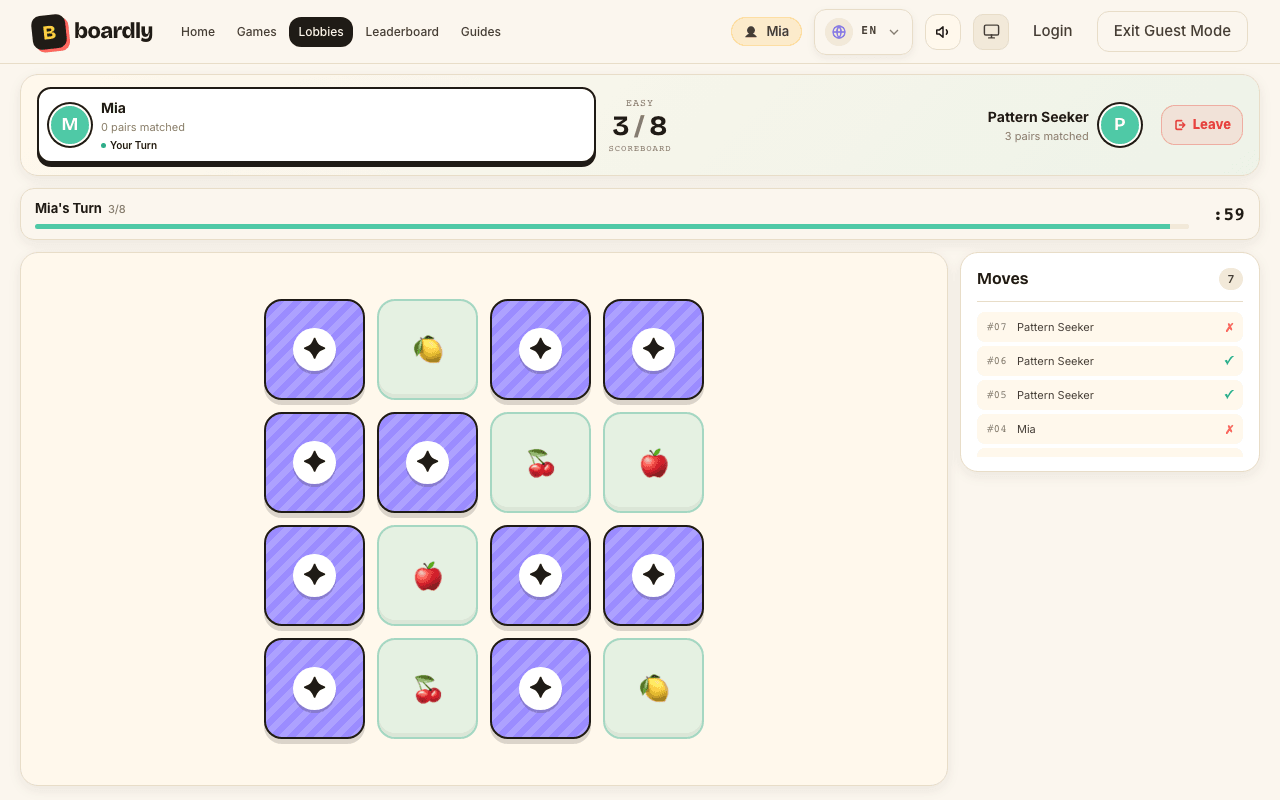
Can you play the Memory card game online with friends?
Yes. Two to four of you share one board in the browser: flip two cards on your turn, keep the pair and go again when they match, and whoever holds the most pairs at the end wins. Easy is 4×4 with 8 pairs, medium 5×4 with 10, hard 6×6 with 18.
What is Memory?
Memory, also called Matching Pairs, is a card game where all cards start face-down. On each turn, a player flips two cards and tries to find a match.
If the cards match, that player scores the pair. If they do not match, the cards turn back over and everyone tries to remember where they were.
How to play
- 1Create or join a lobbyChoose a board size and a turn clock, then share the room code. Up to four people fit at one table.
- 2Flip two cardsReveal two face-down cards on your turn. Both pictures show on every screen.
- 3Keep the matchesA matching pair stays open and scores a point. It also earns you another go.
- 4Find the most pairsWhen all cards are matched, the highest score wins. Equal leaders tie.
Memory rules
- 1On your turn you turn over two face-down cards, one at a time; open or claimed cards cannot be picked.
- 2A match stays face up, scores one point and lets you flip again straight away.
- 3A miss shows for a second or two, then both cards turn back and the next player moves.
- 4If the turn clock reaches zero, your unmatched face-up cards turn back and the turn passes.
- 5The game ends the moment the final pair is claimed.
Memory scoring
Pairs are the only score
Most pairs at the end wins.
- Matched pair1 point
Scored the instant the second card matches.
- Missed pair0 points
Only ends your turn.
- Level at the topTie
No winner is named.
Modes and settings
- Three boards, the host's choice
16, 20 or 36 cards (4×4, 5×4 or 6×6), with the smallest preselected.
- Turn clock
Each turn gets 30, 60, 90 or 120 seconds, 60 by default; Play vs Bot uses 45.
- Three bots
Memory Scout misses most tries, Pattern Seeker hits about half, and Recall Master finds a pair on most.
Memory strategy
- 1.New card first
Open with an unseen card; if you know its twin, the point is yours.
- 2.A safe second flip
Cannot place the twin? Turn a card you already know and reveal nothing new.
- 3.Name it, place it
Every face is a fruit, and "banana, top left" sticks better than a picture.
- 4.Coordinates on 6×6
On the big board, file each card by row and column.
- 5.Start from the corners
Corners and edges are easiest to recall, so pin early finds to them.
- 6.Rehearse while waiting
Between turns, run through every position you know.
- 7.Guess late, not early
With few unknown cards left, a blind flip has real odds.
- 8.Climb the bot ladder
Start with Memory Scout and move up as you improve.
Common mistakes
- Gambling the second flip
A random unknown instead of a known card shows the table one more position for free.
- Looking away
Another player's miss is on screen for a second or two, then it is gone.
- Letting the clock run
Running out the clock scores nothing more, even with a pair you know.
Playing together online
- Friends on their own screens
Share the room code or invite link, and each flip shows on every device as it happens.
- Solo against a bot
Play vs Bot opens a table with a bot already seated, ready to start, or seat a bot in your own lobby.
- Nobody stalls the table
Every player sees the countdown; let it run out and you lose the turn.
- Straight in the browser
Phone, tablet or computer with nothing to install; a guest name gets you a seat.
Why play Memory on Boardly?
- Three difficulty levels for different groups.
- Live board updates for every player.
- Simple controls that work well on mobile.
- Free to play as a guest.
Who it suits
Memory suits mixed ages: a sharp-eyed child can beat an adult, 4×4 makes a quick round, and 6×6 tests keen players.
Where Memory comes from
Matching pairs is an old parlour game known as Concentration, Pelmanism or Pexeso, playable with any deck holding two of each card.
Questions about Memory on Boardly
- Is Memory on Boardly free?
- Yes. All three board sizes, all three bot levels and every turn clock setting are free to use.
- Does Memory work on a phone?
- Yes, in the mobile browser. Moves sit in a tab beside the board, plus chat when two or more people play.
- What if my turn clock runs out?
- You lose that turn, not the game: any unmatched card you had turned over flips back face down.
- How do I play a friend who is elsewhere?
- Send them the room code or invite link; they join from their own device, wherever they are.
- Which board does Play vs Bot use?
- The 4×4 board with 45-second turns, against one bot at the level you pick before it starts.
- Can people and bots share one game?
- Yes. Before the game starts, the host can seat a bot in any empty chair next to real players.
- Can anyone peek at face-down cards?
- No player can. A card's picture only reaches players' browsers once it is turned over, never before.
New to Memory? Read the rules and how to play.